
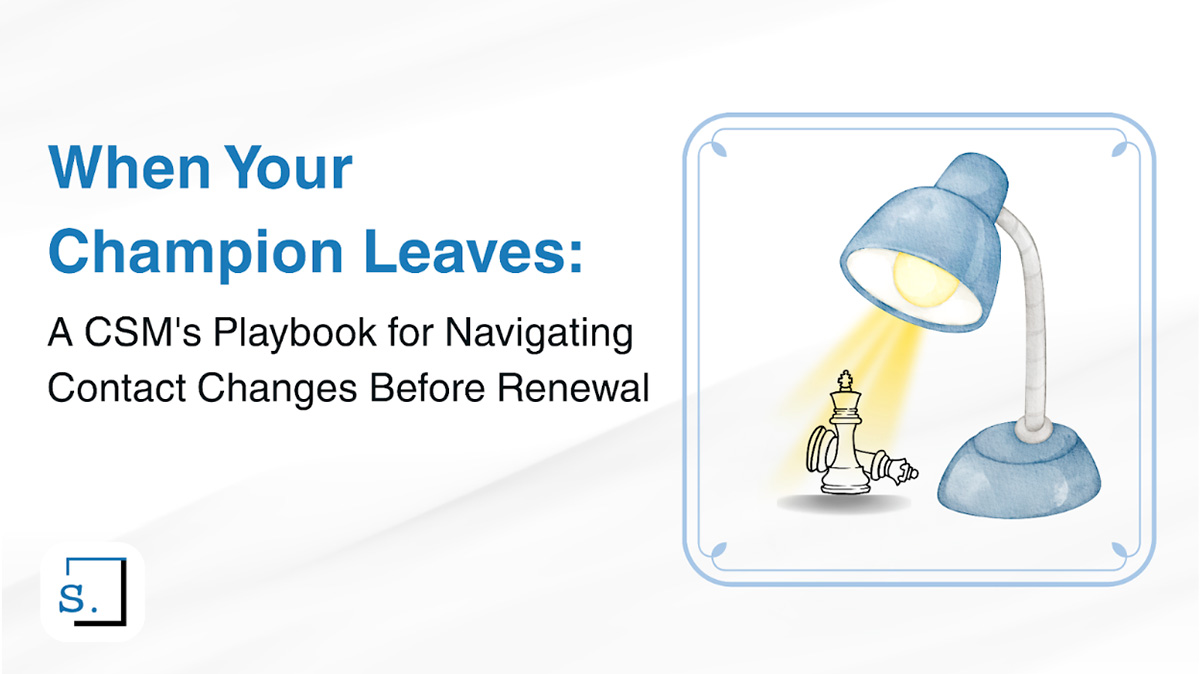
Your stomach drops the moment you hear it: “Yeah, Sarah’s moving to a different company. Her replacement starts Monday.”
You’ve got 60 days until renewal. Usage metrics look solid. The product is delivering real value. But suddenly, all the political capital you’ve built with your champion evaporates, and you’re starting from zero with someone who’s still learning your platform—and openly wondering if they should consolidate vendors.
This scenario plays out constantly in B2B SaaS, especially for companies selling workflow or integration tools in the $25–80K ARR range. A champion departure isn’t just a personnel change; it’s a strategic threat to retention. And the window to respond is brutally narrow.
Let’s talk about what actually works in those critical first two weeks.
Why Champion Changes Are Different (And Why They’re Dangerous)
Before we get into tactics, it’s worth understanding why this moment is so fragile.
Your departing champion wasn’t just a user—they were an advocate. They understood the problems your tool solved, had invested time in mastering it, and had political skin in the game. They likely influenced budget decisions and had relationships with other stakeholders.
The new person? They inherit a tool they didn’t choose, may not fully understand, and face immediate pressure to “clean up” vendor sprawl. That consolidation impulse isn’t personal—it’s how new leaders prove themselves.
The good news: this is solvable. But it requires a deliberate approach in the first 14 days.
Week 1: Intelligence Gathering (Not a Hard Sell)
Your instinct might be to schedule a “let’s meet the new champion” call immediately. Resist that. First, you need information.
Day 1–2: Reach Out to Your Executive Sponsor (If You Have One)
If you have exec-level relationships (even on 1 of 3 accounts), now’s the time to activate them. But frame this as a heads-up, not a crisis call.
Example message: “Hi [Exec], I noticed Sarah transitioned out and [New Champion] is stepping in. I want to make sure we set them up for success. Have you had a chance to brief them on the workflow improvements we’ve made this quarter? I’m planning to connect with them next week, but wanted to touch base with you first.”
This accomplishes several things:
- It alerts the exec that there’s a transition (they may not have even mentioned your tool to the new person)
- It signals you’re thinking about continuity, not just your renewal
- It creates a natural opening for the exec to advocate for you, either directly or by context-setting with the new champion
Day 2–3: Gather Context on the New Champion
Before reaching out directly, do your homework:
- LinkedIn profile: What’s their background? Are they technical or business-focused?
- Their role: Are they in the same position as your departing champion, or different?
- Early signals: Have they logged in? Sent any emails? Interacted with your tool?
- Team changes: Who else moved or stayed? Who influences decisions now?
Look at your usage data too. Has engagement actually dropped since the transition, or is it stable? This matters because it tells you whether you have a relationship problem or a genuine product problem.
Day 3–4: Prepare a Transition Summary
Before you talk to the new champion, create a one-pager for them (and share it with your exec sponsor). This should cover:
- Key metrics: Usage, ROI, time saved, processes improved
- Recent wins: What’s gone better since they started using your tool?
- Current priorities: What’s in-flight? What are you working on together?
- Next milestones: What’s coming in Q3/Q4?
This document serves two purposes: it gives the new person context they may not have, and it anchors the conversation on value, not politics.
Week 2: Building the New Relationship
Now you’re ready to engage the new champion directly. But the approach matters.
Timing: Don’t Rush, But Don’t Wait
Aim for day 7–10 after they start. This gives them time to settle in but doesn’t let silence create a vacuum. A delayed outreach can feel like you’ve abandoned them—or worse, like you’ve been waiting to see if they’d cancel.
The Initial Conversation: Lead with Learning, Not Selling
Your goal in week 1 is to understand, not to persuade. Structure the call around their reality, not your renewal timeline.
Example opening: “Hi [New Champion], I know you’re getting up to speed on a lot of things. I wanted to check in on how [Tool] is fitting into your workflow. No pitch—just want to understand what’s working for your team and where you might be hitting friction points.”
This framing does something crucial: it puts them in the role of expert, not skeptic. You’re asking them to help you understand their needs, not defend the tool.
Listen for Three Things:
- Skepticism triggers: Why do they think consolidation might help? Is it cost, complexity, or something else? Listen without defensiveness.
- Current priorities: What’s their agenda in the first 90 days? Where do they need quick wins?
- Their relationships: Who do they trust? Who influences budget? This is your political map.
Don’t Immediately Counter the “Consolidation” Narrative
If they mention consolidation, your gut says “defend the product.” Don’t. Instead:
“That makes sense. Consolidation can simplify things. Can I ask—when you think about consolidating, what’s the main problem you’re trying to solve? Cost? Complexity? Fewer logins?”
Once you understand the real issue, you can address it. If it’s cost, maybe there’s a discount or a different packaging that works. If it’s complexity, you can highlight integrations that simplify workflows. If it’s politics (proving they’re a cost-conscious leader), you need a different conversation entirely.
The Role of Data and Visibility
Here’s where many CSMs stumble: they hope their relationship-building will carry them through. It might. But without clear evidence of value, a skeptical new leader will side-line the tool.
In the first two weeks, prioritize visibility:
- Show recent wins: “Your team reduced processing time by 12 hours per week in Q2. That’s roughly $35K in annual productivity savings.”
- Highlight adoption: “7 of 8 team members are actively using the platform. Here’s what typical workflows look like…”
- Share industry benchmarks: “Companies like yours typically see X% improvement in [metric] after 6 months. You’re already at that level.”
Data doesn’t replace relationships, but it strengthens them. When the new champion has to justify keeping the tool to their boss, numbers give them ammunition.
When You Don’t Have Executive Relationships
If you’re in situation 2 or 3 (no exec sponsor relationship), your playbook shifts slightly:
- Rebuild from the bottom up: Focus entirely on the new champion’s early wins. Help them look good in their first 30 days.
- Find other advocates: Are there power users on the team? Have them champion the tool to the new leader.
- Offer quick value: Can you streamline a process they’re inheriting? Can you automate something that will impress their manager?
- Plant seeds for executive introduction: After 3–4 weeks of building rapport, ask: “Would it be helpful to connect with [Your Exec] to discuss the roadmap?” This feels natural once the new champion has context.
Monitoring Risk Throughout
Champion changes introduce visibility gaps. You can’t rely on the old relationship patterns, and new ones take time to build.
This is where proactive monitoring becomes essential. Track:
- Engagement trends: Has usage dropped? Are certain team members disengaging?
- Sentiment signals: How are they responding to emails? Are they attending check-ins?
- Milestone completion: Are they hitting expected milestones, or are things stalling?
Tools that automate this monitoring can be lifesavers. Rather than guessing whether you’re at risk, you get early signals—a sudden drop in logins, a missed check-in, a quiet quarter. These friction points tell you when to increase outreach or adjust your approach.
What NOT to Do in the First Two Weeks
- Don’t go straight to exec sponsors (unless you already have a relationship). It signals desperation and can backfire.
- Don’t send manipulative email sequences. New champions spot this immediately and lose trust.
- Don’t assume the tool speaks for itself. The product might be great, but without someone championing it internally, it’s vulnerable.
- Don’t make it about your renewal. It’s about their success. Period.
- Don’t disappear. Silence equals abandonment in their mind.
The Real Playbook: Preparation + Speed + Listening
When your champion leaves 60 days before renewal, you don’t need a trick. You need:
- Quick intelligence gathering (who is this person? what’s their agenda?)
- Exec-level context-setting (if available)
- Value-backed initial conversation (show impact, listen to concerns)
- Ongoing visibility (into engagement, sentiment, and friction points)
- Continuous relationship investment (consistent, non-manipulative touch)
The first two weeks set the tone. Move with urgency, but lead with their interests, not yours. The new champion is evaluating you right now—not just the tool, but whether you’re a partner who understands their world or a vendor trying to save a deal.
If you’re managing multiple at-risk accounts and trying to track which ones need the most attention, visibility becomes critical. Knowing which customers are showing early churn signals—whether from champion changes, engagement drops, or friction points—helps you allocate your limited time to the accounts most likely to slip away.
Turning Reactive Response Into Proactive Strategy
Here’s the uncomfortable truth: most CSMs react to champion departures. They notice it when the renewal conversation gets awkward or when they lose the deal.
The teams that protect revenue are the ones who spot these transitions early, understand the risk, and move with intention in that critical 14-day window.
If you’re managing multiple accounts and can’t track every LinkedIn connection or org change manually, tools like Scratch Frameworks can help. They flag at-risk customers automatically (including detection of engagement drops that often follow key personnel changes) and suggest intervention strategies based on behavioral science and your specific situation. It’s the kind of early warning system that lets you move strategically instead of reactively.
But regardless of the tools you use, the playbook is the same: move quickly, listen carefully, build stakeholder relationships, and prove value before the conversation becomes “should we keep this?” instead of “let’s renew this.”
Key Takeaways
- Week 1 is about intelligence and relationship building—not selling
- Find the real decision-maker(s) early—the new contact may not own renewal
- Activate executive sponsors strategically—frame it as business alignment, not a rescue
- Document value in business terms—”hours saved” and “error reduction,” not feature lists
- Make the new contact the hero—give them air cover to say yes
- Move fast—that 14-day window is real, and every day matters
Champion departures will always carry risk. But with intention, empathy, and strategy, you can turn a vulnerable moment into a smooth renewal and an even stronger relationship with your new contact.